
The operating layer for company-controlled AI agents.
QUI is a local-first cognitive operating system for creating, coordinating, and governing persistent AI agents across real work.
It can run on customer-controlled infrastructure, including owned servers, private cloud, or a dedicated VPC, rather than only inside a vendor's shared SaaS environment.
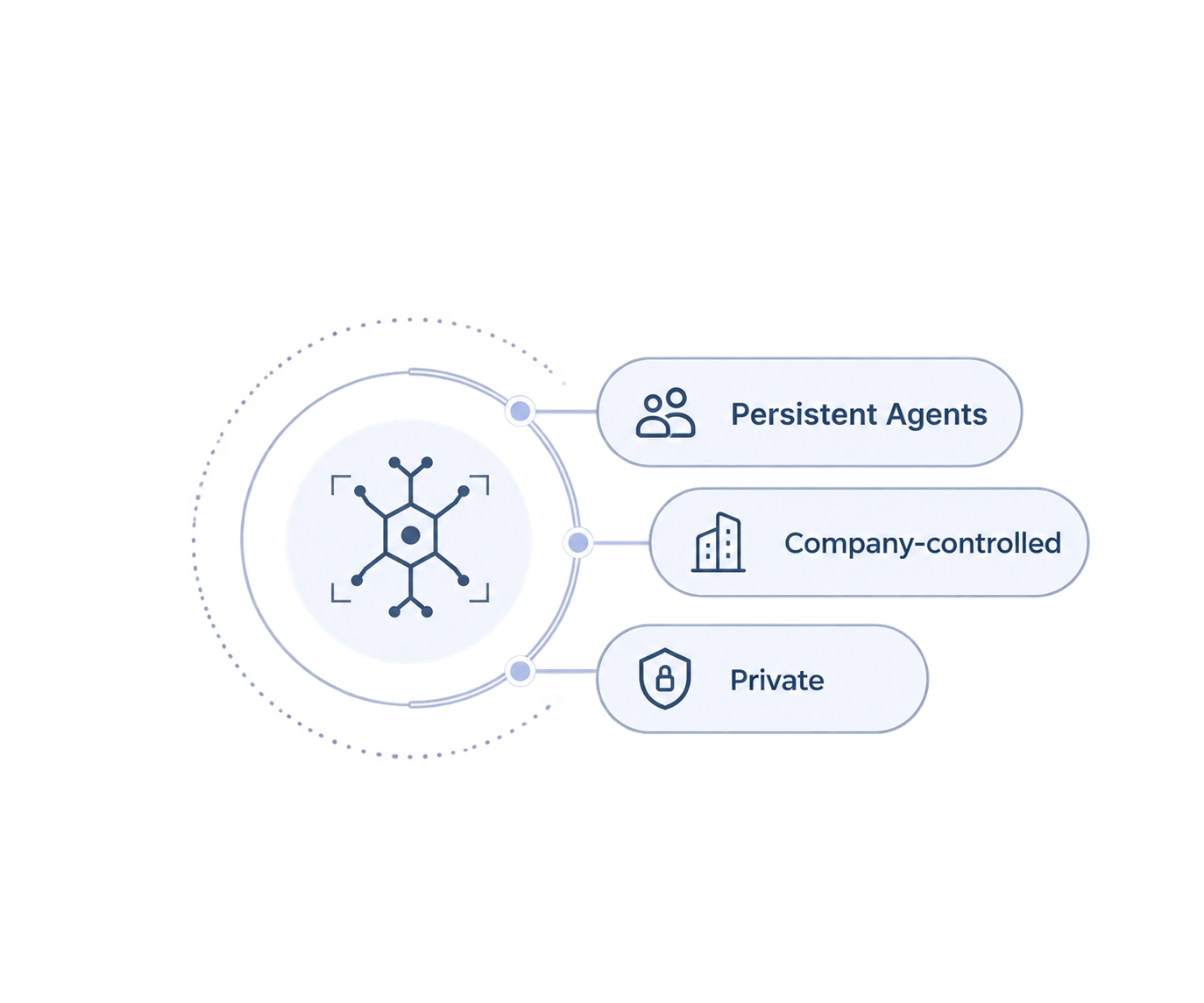
What QUI Is
QUI is not a chatbot wrapper and it is not only a developer framework.
It is a platform where companies can define agents, give them memory, connect them to approved tools, place them inside workflows, route them through selected models, and keep humans in control of important decisions.
Platform Pillars
Sovereign AI Infrastructure
Run the intelligence layer in a company-controlled runtime. Store conversations, memories, character configuration, knowledge, and workflow logic where the company can govern them.
Deploy that runtime on infrastructure the customer controls when data sovereignty, privacy, security policy, latency, or regulatory control require it.
Persistent Agents
Create agents with stable identity, long-term memory, role-specific knowledge, tool permissions, and behavior that can evolve under user and admin control.
Cognitive Architecture
Move beyond prompt chains. QUI gives agents structured memory, reasoning modes, workflow logic, multi-agent coordination, recursive thinking, and state-aware processing.
Human-Controlled Autonomy
Agents can do more than respond. They can reason, act, and coordinate, while human checkpoints, permissions, budgets, and review paths keep authority clear.
Governance and Tenancy
Scale agents across teams and hosted contexts with boundaries for access, permissions, tenant isolation, model routes, and tool authority.
Qate provides the multi-user workspace and governance layer for shared QUI environments. It helps teams manage workspace membership, roles, permissions, access boundaries, approvals, and audit visibility.
Use RBAC to assign roles such as Admin, Developer, Operator, Auditor, or Viewer and define who can create agents, edit prompts, access memory, view conversations, use sensitive models, or alter infrastructure.
Evidence and Accountability
Keep work inspectable. Autonomous workflows need records of what happened, what rules applied, where approvals occurred, and what outputs were created.
Audit logs add a tamper-resistant record of critical system actions, including logins, configuration changes, data access, agent deployments, permission changes, and timestamps for investigation, accountability, security monitoring, and compliance.
QUI is designed around the security and AI governance principles reflected in ISO/IEC 27001 and ISO/IEC 42001. Certification is planned; QUI is not currently ISO-certified.
Model and Deployment Choice
Use managed cloud models, local inference, or private owner-controlled compute. QUI keeps the agent infrastructure separate from any single model vendor.
Core Product Surfaces
Anima
The character engine. Anima owns agent identity, memory context, model selection, personality, tool configuration, system prompts, and the agentic loop.
ThinkThing
The visual workflow builder. ThinkThing lets teams design cognitive workflows, multi-agent architectures, approval gates, branching logic, and monitored execution.
Strings
The conversation layer. Strings organizes direct chat, multi-character threads, M2M messaging, and external channels into persistent conversation containers.
Memory and Cortex
The continuity layer. Memory stores semantic context. Cortex consolidates and maintains memory so agents can learn from ongoing work.
Autothink and FractalMind
The reasoning layer. Agents can use structured thinking strategies, recursive exploration, adversarial checking, and synthesis workflows.
Qonscious
The state layer. Qonscious tracks coherence and conversation state so agent behavior can become more consistent and context-aware.
Qate
The multi-user workspace layer. Qate supports shared QUI environments where teams can manage members, assign roles, control access to agents and memory, coordinate approvals, and review audit activity.
Who It Is For
QUI is built for organizations that want AI agents to become operational infrastructure, especially when privacy, continuity, governance, and human control matter.
Ideal teams include:
- Leadership teams building strategic AI capacity
- Companies with sensitive knowledge or IP
- Operations teams coordinating work across channels
- Engineering and IT teams adopting agent workflows
- Research teams that need persistent context and synthesis
- Organizations planning multi-agent or multi-tenant deployments