
Agents that remember the business, the work, and the way your team thinks.
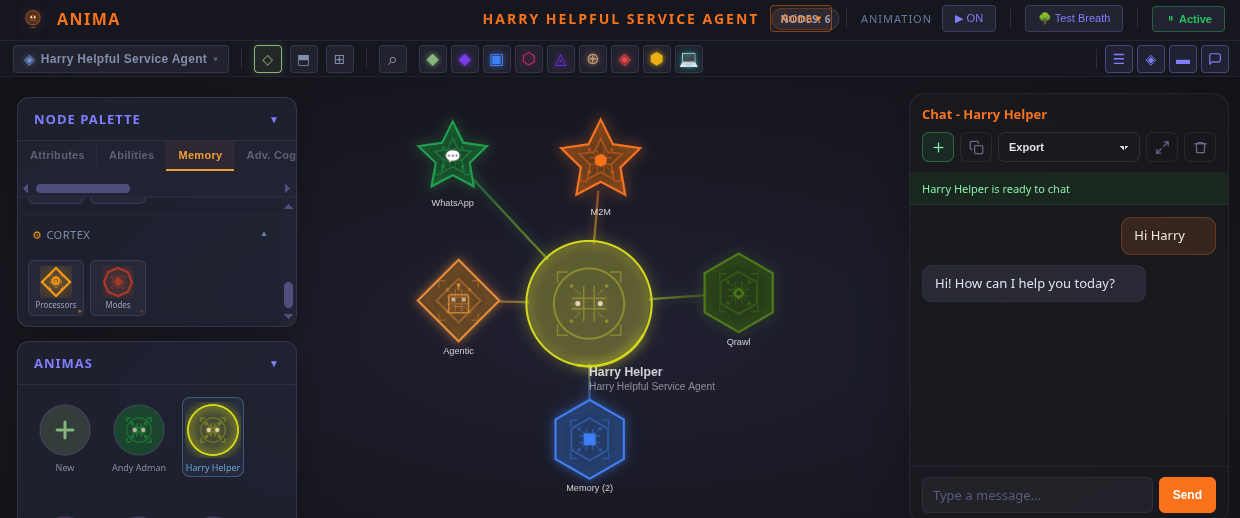
QUI agents are persistent entities with identity, memory, tools, role context, and governed behavior across time.
The Problem With Stateless AI
Most AI tools are built around sessions. A person asks, the model responds, and the useful context often disappears or stays trapped in one person's account.
For operational work, that is not enough.
Companies need agents that can:
- Remember relevant history
- Carry role-specific knowledge
- Understand recurring workflows
- Know the people, priorities, and constraints around the work
- Improve from repeated interaction
- Stay consistent across channels and tasks
What Persistence Means In QUI

Persistence is not just saving chat logs.
In QUI, agents can have:
- Stable character identity
- Configured personality and voice
- Human-authored system prompts
- Controlled self-authored prompt updates
- Semantic memory
- Knowledge bases
- Tool and workflow permissions
- Model preferences and token limits
- M2M communication permissions
- Channel bindings and conversation context
How Memory Works
Memory is what turns a capable model into a persistent agent. In QUI, memory is a governed service, not an unbounded log of everything an agent has ever seen.
When an agent works, the Memory Service stores meaning, not just text. Memories are held as semantic associations, so an agent can retrieve what is relevant to the task in front of it instead of replaying an entire history. Retrieved memory enters the next response as context, which is how an agent builds on prior work rather than starting over each session.
Over time, Cortex consolidates memory. It preserves useful continuity and reduces noise, so agents stay coherent as the volume of interaction grows.
Because memory shapes behavior, it stays under company control:
- Memory is scoped per agent, so roles do not leak context into one another
- Memory writes can require human approval before they become durable
- Access and retention follow the same permissions as tools and channels
- Sensitive work can be routed and remembered under stricter policy
The result is an intelligence layer that compounds inside the company, with boundaries you can see and govern.
Why It Matters
Persistent agents become useful because they compound context.
An executive agent can remember priorities and unresolved decisions. A research agent can build on previous investigations. A customer operations agent can track recurring issues. An engineering agent can understand release patterns, runbooks, and architectural decisions.
The company does not start from zero every Monday.
Digital Brain
Anima
Anima is the source of truth for character identity, behavior, model routing, tools, and prompt assembly.
Memory
The Memory Service stores semantic memory with associations, not only keyword history.
Cortex
Cortex consolidates memory over time, helping agents maintain useful continuity instead of accumulating noise.
Strings
Strings gives conversations persistent containers where direct chat, external channels, and multi-agent work can share context.
Applied Use Cases
- Executive memory agent
- Persistent research analyst
- Engineering delivery agent
- Customer response agent
- Internal knowledge agent
- Strategy room facilitator