
Turn raw model output into structured, governed cognition.
QUI gives agents memory, reasoning, workflows, state, and collaboration patterns so AI work can become more reliable than prompt improvisation.
The Problem
Large models are powerful, but raw model access is not the same thing as an operational intelligence system.
Without architecture, AI work often depends on:
- Prompt quality in the moment
- Individual user skill
- Hidden context in a chat thread
- Manual copy-paste between tools
- No clear reasoning structure
- No durable memory
- No reliable approval path
- No repeatable execution model
QUI's Cognitive Stack
QUI adds structure around the model.
Memory
Agents can retrieve and build semantic memory across conversations, files, and workflows.
Cortex
Memory can be consolidated, deduplicated, revalued, and processed over time.
Autothink
Agents can use thinking strategies such as analytical, comparative, reflective, causal, scenario planning, and meta-cognitive reasoning.
ThinkThing
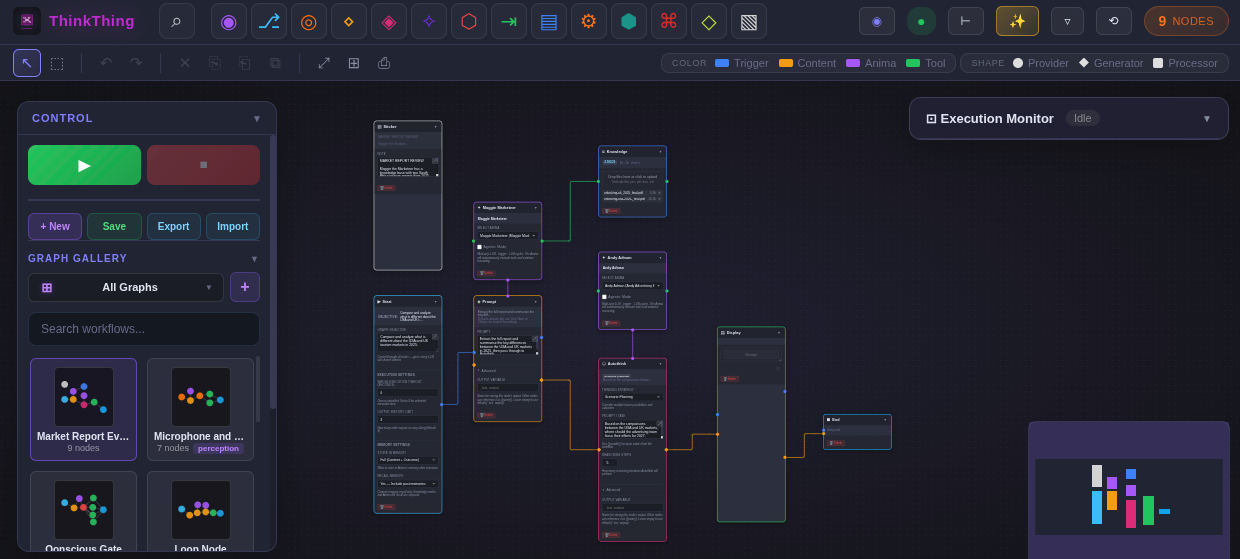
Teams can design visual cognitive workflows with branching, review gates, parallel execution, variables, tool calls, and multi-agent coordination.
FractalMind
Complex problems can be explored recursively from multiple directions with synthesis and gap checking.
Qonscious
Conversation state and coherence can be tracked so agents have more structured context around interaction.
Business Benefit
Cognitive architecture makes agent behavior easier to design, repeat, inspect, and improve.
That matters when AI moves from personal productivity to company operations.
Applied Use Cases
- Strategy evaluation
- Market intelligence
- Incident response
- Complex research synthesis
- Engineering planning
- Policy review
- Multi-agent debate and critique