
Bring the intelligence infrastructure under company control.
QUI gives organizations a local-first runtime for the agents, memory, workflows, and governance that make AI useful in real operations.
Customers can self-host QUI on infrastructure they control, such as their own servers, private cloud, or VPC, instead of using a vendor's shared SaaS environment.

The Business Problem
AI is becoming part of how companies think, decide, and execute. But in many organizations, that intelligence layer is scattered across cloud chat products, browser tabs, individual accounts, and vendor-controlled workspaces.
That makes it hard to answer basic questions:
- Where does the agent remember?
- Who controls its instructions?
- Which model sees this request?
- Which tools can it use?
- What evidence exists after it acts?
- Can this workflow be moved, inspected, or governed?
QUI's Answer
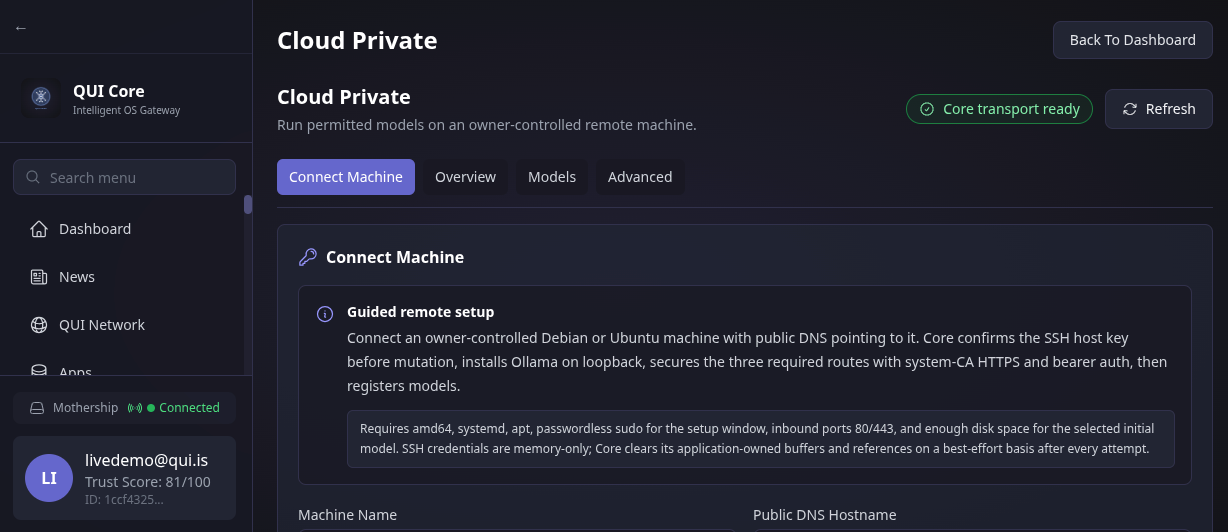
QUI puts the core intelligence layer in a company-controlled runtime.
The platform is local-first by design. Conversations, semantic memory, knowledge bases, character configuration, and workflow logic live in the QUI runtime by default. Cloud model routing is a controlled choice, not the center of the architecture.
That runtime can be deployed inside the customer's own infrastructure boundary: on owned servers, in a private cloud, or in a dedicated VPC. This matters for data sovereignty, privacy, security policy enforcement, latency-sensitive workloads, and regulatory control.
What Companies Control
- Agent identities and roles
- Persistent memory and knowledge context
- Tool and integration permissions
- Workflow design and execution rules
- Human approval points
- Model routing and deployment options
- Hosting location across owned servers, private cloud, or VPC
- Cost and token limits
- Cross-agent and cross-instance communication rules
Why This Sells
Sovereign AI infrastructure is not a technical preference. It is a strategic control point.
Companies need the freedom to adopt powerful AI while keeping ownership of the operational layer around it. QUI lets them use external models without allowing external products to become the default home of company intelligence.
Applied Use Cases
Sensitive Strategy Work
Leadership teams can run persistent strategy agents where memory, context, and workflow history stay under company control.
Product and IP Research
Research agents can build continuity around market analysis, product decisions, and competitive intelligence without scattering that work across tools.
Regulated or Private Operations
Teams can choose local or private inference routes for sensitive workloads and reserve managed cloud models for lower-risk work.